

The CDC has confirmed cyclosporiasis cases in Utah as part of a national outbreak. As of July 9, 2026, 843 domestic cases had been reported across 31 states, with 86 hospitalizations and no deaths. Utah’s confirmed count remains small (1 to 10 cases as of early July), but at least 31 states have now reported cases, and health officials haven’t pinned down the source.
What It Is
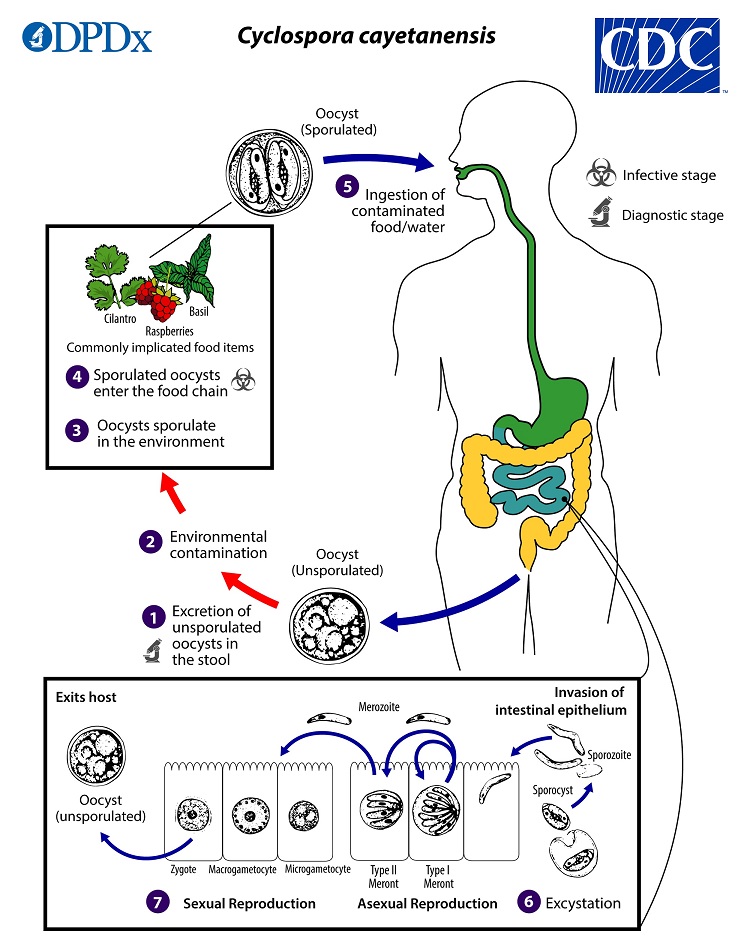
 Cyclosporiasis is caused by Cyclospora cayetanensis, a microscopic parasite that infects the small intestine. People become sick after eating or drinking food or water contaminated with the parasite. Symptoms show up 7 to 14 days after exposure and typically include watery, sometimes explosive diarrhea, cramping, nausea, fatigue, and weight loss that can persist for weeks if untreated.
The parasite doesn’t spread person to person easily. Oocysts shed in feces need one to two weeks outside the body before they become infectious, so contamination almost always traces back to a food or water source, not direct contact with a sick person.
Why this is also a water problem, not just a produce problem
Coverage of this outbreak has rightfully focused heavily on produce (berries, herbs, leafy greens), and that’s a real pathway: contaminated irrigation water carries the parasite onto crops before they ever reach a store shelf. The same organism travels through drinking water and recreational water too, and it can survive standard drinking water treatment processes like chlorination.
Cyclospora oocysts sit in the same resistant family as Cryptosporidium. Both have a tough outer shell that lets them shrug off routine chlorination at municipal contact times and concentrations.
The Two Barriers That Actually Work at the Point of Use
- Ultrafiltration (UF): Cyclospora oocysts are large as pathogens go (roughly 8 to 10 microns). A UF membrane with an absolute pore rating removes them by size exclusion: if the organism can’t physically fit through the membrane, it doesn’t get through, regardless of how chlorine-resistant it is. This is a mechanical barrier, not a chemical one, so it doesn’t depend on contact time or water chemistry to work.
- Ultraviolet (UV) disinfection: UV doesn’t kill oocysts in the traditional sense; it damages their DNA so they can’t reproduce, which is what actually matters for infection risk. Properly sized and maintained UV systems are effective against chlorine-resistant protozoan parasites, which is exactly why UV is standard practice at treatment facilities dealing with Cryptosporidium risk.
Used together, UF and UV cover each other’s blind spots: UF is a physical barrier that doesn’t care about UV lamp output or dose, and UV catches anything small enough to be a question mark on a filter rating. Neither one depends on chlorine doing a job it isn’t built to finish.
What we recommend if you’re asking
Utah cities work extremely hard to provide water that meets and exceeds Federal minimum standards. If you are concerned about protecting your family beyond what the city provides, a point-of-entry or point-of-use system combining ultrafiltration and UV will protect you without relying on boiling water or changing how you use your kitchen. This will give you persistent protection, and peace of mind. Cyclospora outbreaks recur every spring and summer, and this year’s is larger than most on record.
If you want a straight answer on what your family needs, we’ll walk through it with you without any sales-pressure, and we’ll tell you plainly what will or won’t work for you.
Sources:
CDC Cyclosporiasis Surveillance (updated July 9, 2026)
ABC4 Utah, “Nationwide outbreak of diarrhea-causing cyclosporiasis reaches Utah, CDC reports.”


